The Letter and Spirit of Creative Commons
At last week’s Bibliothekartag in Erfurt, Germany, I heard a talk by librarian Nicole Graf from the library at the Eidgenössische Technische Hochschule (Swiss Federal Institute of Technology) in Zürich, Switzerland. It was quite interesting, but also gave me the feeling that some institutions are playing fast and loose with concepts such as open access and legal constructs such as Creative Commons. I’ll try to explain this here, but will caution all that this is a long story.
The ETH library has, as do many libraries, a fairly large image archive, which they have been steadily moving online. Until late last year, they were charging for all usage of their digitized images, at which point they decided to switch to open access and begin applying a Creative Commons Attribution-Noncommercial-No Derivative Works license to their images. At face value this is a good move, and one to be greeted enthusiastically. It quickly gets complicated, however. Read more…
Not fast, Twitter fast
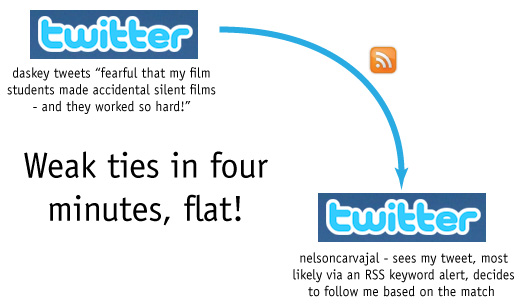
As many do, I have a love/hate relationship with Twitter. Something just happened, however, that made my head spin. I was berating my poor students this week about Enterprise 2.0 and extolling the virtues of weak ties (me channeling Andrew McAfee channeling Mark Granovetter), since I have clearly seen the benefit of these weak ties through my use of various 2.0 technologies.
I just issued the following tweet at 8:38 p.m. my time:

At 8:42 p.m. I received an email from Twitter notifying me that I had a new follower. Oh great, I thought, another spam follower, but clicked the link to see his/her profile anyway. Turns out not to be a spammer, but someone who describes himself on Twitter as a writer/filmmaker. Clearly he has a feed for the keyword film or something like that, but FOUR MINUTES! Wow. I’m trying to become more adept with Illustrator, so did a little practice to turn this story into a picture:
Der Bundestag, Open Source und Social Networking
Jetzt habe ich alles gesehen. Heute habe ich zufälligerweise entdeckt, daß die deutsche Demokratie auf einer Open-Source-Basis steht. Also, nicht ganz, denn sonst würde ich in Angela Merkels Quellcode ein bisschen herumsuchen und versuchen, die Bugs in ihrer Menschenfreundlichkeitssubroutine zu entfernen. Aber immerhin werden öffentliche Petitionen mittels quasi Open-Source-Software gesammelt, bearbeitet und kommentiert. Da staune ich. Leider ist die dafür verwendete Software, Simple Machines, kein orthodoxes Open-Source-Projekt, aber doch quelloffen und kostenlos.
Ganz zufällig war diese Entdeckung nicht. Ich habe in Twitter ein Tweet vom deutschen Bibliothekar Edlef, den ich seit Jahren aber nur virtuell ‘kenne’, gesehen, wo er einen Blogpost “Petition Reloaded” verlinkt hat. Er hatte eigentlich wiederum den Link von einem anderen Twitterer. Also, ich habe den Link geclickt, den Post hier gelesen und dadurch den Link auf die obengenannte Bundestagsseite gefunden. Alles interessante Lektüre, und mittels dieser Technologien ganz schnell und einfach. Web 2.0 wird oft heutzutage belächelt, aber es hat was.
Ex Libris blogs, oh my!
Via a Twitter friend, I learned today that Ex Libris has started two blogs. In a demonstration of how beholden many still are to an earlier world, they issued a press release to announce a blog. Hmm.
On the one hand, this is good, but experience should tell us that those who use a press release to announce a blog tend to use the blog as a mouthpiece for the organization. In other words, we should all go there and read their press releases. Checked out the blogs, and found what I expected to some degree. One of the blogs has little content (Initiatives), and some large gaps between posts. The other blog (Commentary from Carl Grant, president of EL North America) suffers from a malady one wishes would go away, that of the overly long post. My heavens, cut them into pieces, please. It is perhaps not surprising that he has no comments, since it would mean that someone made it through the whole post.
When companies jump in like this, it can be a good and bad thing. On the positive side, they are trying to be more transparent and interact with customers in new ways. On the negative, they tend to treat it as PR, as I mentioned above. Most companies also fail to recognize the reciprocity factor in the blogosphere, which dictates that your readership is largely related to your degree of participation in your sector of said blogosphere.
Allesfresser
Neulich hat eine Studentin (BV) mich gefragt, ob wir die Menschen dazu erziehen könnten, für Inhalte aus dem Internet zu bezahlen (Pay-per-view oder Abo). Ich habe so geantwortet:
Bezüglich dieser Erziehung bin ich äußerst skeptisch. Mit ganz wenigen Ausnahmen, wo eine Informationsquelle sich definitiv als die Quelle schlechthin etabliert hat, können die meisten Quellen nicht von sich behaupten, hier finden Sie immer das beste Informationsangebot. So eine Ausnahme ist die Wall Street Journal. Die Qualität ist hoch, aber auch die Zusammensetzung der Stammkundschaft spielt hier eine große Rolle. Die Leser der WSJ verdienen i. d. R. recht ordentlich, also eine Kleinigkeit zu bezahlen, gerade für die Zeitung, die man einfach gelesen haben muß, ist kein wesentlicher Umstand. Solche Quellen sind selten zu finden. Schon die New York Times, die als die einzige ‘Landeszeitung’ von Qualität der USA längst eine Sonderstellung hat, scheiterte mit Pay-Per-View und Online-Abonnements. Scheitern ist zu stark formuliert. Besser wäre es zu sagen, der erhoffte Erfolg blieb aus. Read more…
Warum bloggen?
Von Menschen, die nicht bloggen und sogar behaupten keine Blogs zu lesen (was heutzutage so gut wie unmöglich ist, da so viele sog. Websites tatsächlich nichts anderes als Blogs sind), wird oft gesagt, Blogs sind nur ein lautes Quatschen halbgebildeter Menschen, die die Banalitäten Ihrer Leben der Öffentlichkeit zugänglich machen. Das mag zwar in vielen Fällen zutreffen, aber alle Blogs in den selben Topf zu werfen wäre eine grobe Vereinfachung. Es gibt eigentlich weniger um die jeweilige Qualität als die Frage, ob es Menschen gibt, die sich für Ihre Aussagen interessieren. Read more…
Schöne Grüße
Da ich schon einige Blogs habe, kann es eigentlich schaden, noch einen dazuzufügen? Ich halte Sie hier am Laufenden und erzähle einiges von diesen tollen 2.0-Anwendungen.


 The Bibliobrary