DRM: This is getting silly
Sometimes I feel like some of my lectures here at the HTWK Leipzig devolve into long tirades against the unwise practices of media companies with regard to digital rights management. Testing legal users’ patience by subjecting them to endless warnings and incompatibilities does not strike me or pretty much anyone else other than media companies as a good idea. Latest case in point: a friend posted a YouTube video on his Facebook page today. I clicked the thumbnail to start the clip and saw this instead:

Winning friends, one slap in the face at a time
[Translation: This video contains content from Sony Music Entertainment. It is no longer available in your country.] I find this doubly annoying. For one, I cannot see the fake trailer to the Titanic sequel, which pretty much lowers my quality of life a few notches right there. Adding to the agony is the fact that the content was once available, but no longer is, which makes me feel like I missed out on some great moment of free-ranging content. Smack, smack. Ouch.
This is not good customer management, and just drives people toward illegal sources for their media. As this graphic humorously portrays (from Reddit user Question Everything via Leander Wattig), pirated media is easier to use than legit content, which pretty much anyone over the age of ten knows. This needs to change, or things are just going to get worse.
Say, if anyone living in a country where this content flows freely felt like ripping and shipping this video, I would sure appreciate it. The FF extension 1-Click YouTube Video Downloader works like magic.


Article on ebooks
I have an article in a forthcoming issue of Information Standards Quarterly (ISQ) on ebooks. Thanks to the wisdom of its editorial board, authors have permission to self-archive their articles wherever and however they choose, so in advance of the print edition, here is the publisher’s PDF for my loyal readers (all ten of you!). Enjoy!


Preisbindung erlöse uns
Sorry, English readers, this topic calls for German since it concerns the German law regulating book prices.
Gestern auf der Leipziger Buchmesse habe ich einen interessanten Vortrag von Anwalt und Preisbindungstreuhänder Dieter Wallenfels gehört. Schon den Titel fand ich höchst interessant:
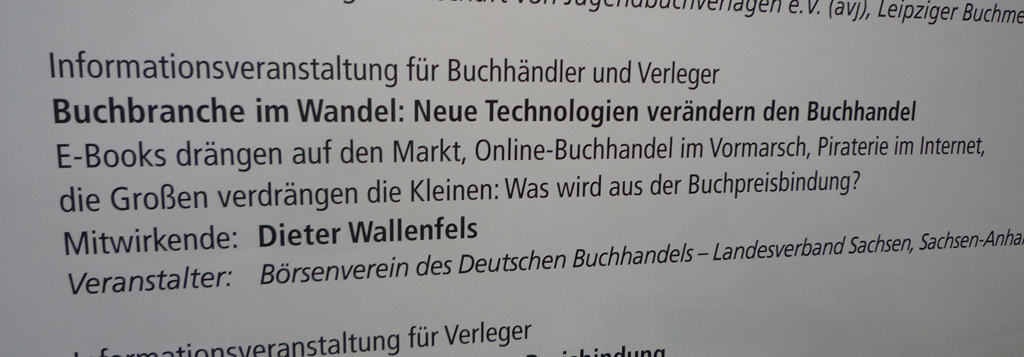
Man kann hier nicht verkennen, wieviel Angst und Bangen hinter diesem Titel steckt. Ich wollte eigentlich sehen, ob Wallenfels die (nicht ganz so) “neuen Technologien” oder eher die Preisbindung betonen würde. Als Preisbindungstreuhänder, hätte ich von Wallenfels erwartet, er würde in erster Linie von der Buchpreisbindung reden, und er hat nicht enttäuscht.
Man könnte seine Rede so grob zusammenfassen: das gedruckte Buch und der Buchhandel kann sich nur mit Hilfe der Preisbindung behaupten, und eBooks müssen deswegen der Buchpreisbindung unterworfen werden. Das ist natürlich keine neue Botschaft. Wallenfels findet es möglich, dass man verhindern könnte, dass eBooks aus dem Ausland nach Deutschland verkauft werden könnten, also vermutlich mit DRM, was natürlich die Rechte der Konsumenten grob missachtet. Wallenfels erzählte auch von persönlichen Gesprächen mit einem ihm befreundeten Richter vom Bundesgerichtshof, der der Meinung ist, eBooks sind auf jeden Fall preisbindungsfähig. Diese Nachricht fand die Moderatorin erfreulich. Ich war dagegen ziemlich empört, dass ein Justiziar des Börsenvereins von seinen freundschaftlichen Gesprächen mit der höchsten deutschen Rechtsinstanz in aller Öffentlichkeit redet. Das ist meines Erachtens keine Justiz, sondern eher Klientelpolitik. Haben die Verbraucherschutzorganisationen auch diesen Zugang? Wohl kaum.
Im Laufe seiner Rede hat Wallenfels auch Open Access erwähnt, und in diesem Zusammenhang locker mit Tatsachen gespielt. Wallenfels hat die externen Gefahren für den Buchhandel aufgelistet (wobei OA doch eher eine “Gefahr” für STM-Verleger als für den Buchhandel ist), und nachdem er Open Access als gefährlich bezeichnet hatte, deutete er unverkennbar an, dass Open Access ein Verstoß gegen Urheberreicht sei. Genau gesagt hat er OA-Werke als “bisher urheberrechtlich geschützte Werke” bezeichnet. Dass ein Anwalt, der eng mit dem Börsenverein arbeitet, so locker grobe Unwahrheiten verteilt, sollte nicht besonders überraschen. Wer aber nicht weiß, oder besser gesagt nicht wissen will, dass Open Access eigentlich recht wenig mit Urheberrecht zu tun hat (zumindest nicht in dem Sinne, den Wallenfels hier meint), verdreht nur die Wahrheit.
Panische Branchenexistenzangst kenne ich sehr gut als Bibliothekar. In den letzten fünfzehn Jahren redet man permanent vom Untergang der Bibliotheken. Jetzt aber stellen wir fest, dass wir nicht nur noch da sind, sondern dass wir ganz neue Aufgaben entdeckt haben und orientieren uns (endlich!) an die Zukunft statt uns an der verlorenen Vergangenheit fest zu klammern. Was man in solchen Zeiten braucht, wäre Innovation und Experimentierfreudigkeit. Die Hoffnungen an der Gesetzgebung zu knüpfen kommt mir als eine schlechte Überlebensstrategie vor.


What is a librarian?
At a recent faculty meeting here–where the topic of discussion was the new master’s program starting this semester–a colleague referred to “core competencies” for librarians. I chimed in at that point, asking what are exactly such competencies in 2010. I believe that they do, in fact, exist; if they did not, there would be no point in being a librarian nor calling it my profession. In fairness to my colleague, and as an exercise in nailing this down for myself, here are my thoughts on what those competencies are:
- knowledge and appreciation of the history and development of libraries
- high awareness of the universal values of the profession; one could describe these in many ways, but for me it boils down to providing as much information to as many people for as little cost (to them) as possible
- understanding of the various tasks performed in libraries: collection development, presentation of online content, reference service, cataloging, acquisitions, etc.
- expertise in at least one of those areas, and enough knowledge of the others to speak intelligently with all colleagues
- way above average skills in finding information, whether in print or online
- facility with information technology, i.e.- able to use or quickly learn any basic consumer technology and able to grasp at least the architecture of networked systems
This is not a definitive statement, just some thoughts. I realize as well that such a list is like attaching a lightning rod to one’s head in a thunderstorm, and we likely all have our ideas about these things. What is on your list?


Apple v. Adobe – and we are the losers
As pointed out in the New York Times and by many others, Apple chose not to support Flash video on the iPad. Anyone who owns an iPhone or iPod Touch is already familiar with this particular issue, but somehow it takes on entirely new dimensions (pun intended) on a larger screen device.
Apple claims that Flash is a battery hog and is too slow, but offers little evidence to support these assertions. What is undeniable is that Flash is one of the most ubiquitous technologies for Web content, present on virtually every personal computer as with Acrobat Reader. Moreover, many of us consume incredible amounts of Flash content, whether it be sports highlights, magazine content, or just random videos from one of the many video sources on the Web.
Apple touts the newish HTML5 as the savior for online video. Great. It bears noting that Apple is a part owner of the patents for HTML5. So what we have here is a standoff between two media giants, each battling for control of the marketplace.
Adobe, as anyone with even a passing knowledge of media creation knows, is by far the largest publisher of software for media development, from text to video and everything in between. They have a near monopoly in certain segments of that world, and applications such as Photoshop, Illustrator, and Dreamweaver are part of the fabric of our modern landscape. They make a ton of money with these applications, and protect their assets with vigor.
In the popular mind, Apple is primarily a maker of hardware, but somewhere back around the launch of the first iPod, Apple clearly decided that the future was in becoming a media giant. By selling apps for the iPhone (most of which are simply media content, e.g.- books, games, etc.) and by selling video and audio (and now books) through the iTunes store and soon via iBooks, Apple has created revenue streams that go beyond the life of any particular hardware device. There is also a much larger margin with digital media than with hardware.
As a normal consumer and non-stockholder in either Adobe or Apple, I really do not care about their margins or stock dividends. What I do care about is consumer choice, and keeping content as low-cost as possible. All of this wrangling over Flash will ultimately cost consumers more money as we line up to purchase our media from fewer sources or, in Apple’s greatest fantasy, from Apple alone. This is not a fantasy I am spinning. Within days of its launch, Apple’s platform rewrote the rules for ebook pricing. The loser: readers.
Somehow my enthusiasm for the iPad is waning by the second. Microsoft took a beating back in the days because, oh horror, they tied the browser (and their media player) to the operating system. For most consumers, it didn’t matter a rip. We happily used Netscape until it died, and picked right up when Firefox came on the scene. Cost to me: a few minutes for installation. Benefit: browsers galore, and free choices. Even if one uses Microsoft’s software, the differences for users are negligible, of concern only to Web designers and sys admins.
Not so with Apple. By spreading their tentacles into our media consumption and creating revenue streams for themselves, they have fundamentally altered the game, and we will be the losers. Where is the backlash? I suppose when the “press” applauds giddily when a guy in a black turtleneck introduces a large-screen iPhone, we cannot expect much objectivity.
Is that a maxi or mini iPad?
Sorry, cannot help myself. This may go down in history as one of the worst product names ever. This is what happens when the boys do not let the girls in on their decisions. I should, however, be grateful to Apple. Whenever I teach the topic of marketing and the importance of understanding culture when marketing products, I use examples such as the Ford Pinto and Chevy Nova. I now have a brand new example to add to the pack. Thanks, Apple.
Had a student come up to me after class within 36 hours of the Jobs-a-thon and ask me what I thought of the iPad. It does not take a media genius to figure out that Apple is going to sell kajillions of these devices. It is also clear that this has significantly raised the stakes in the budding ebook wars, and it is likely safe to assume that the Kindle will now die a slow but steady death.
But are we all so naive to think that this will be a troublefree device? I love my iPod Touch, but its battery life is horrible. Enlarge the screen and even with a larger battery I can only imagine that the iPad will suffer from a similar problem. Apple claims ten hours, which in plain talk means six, which means after a year of charging cycles four, at best. Apple is a computer hardware manufacturer still bound by the rules of physics, and the simple fact is that battery technology is not advancing at the clip with which devices demand it, whether one is speaking of handheld devices or cars. The big breakthrough is still before us. Replacing the battery will be prohibitively expensive, too, as experience has shown us, which renders the iPad yet another disposable device after two or three years.
I am also curious to use the virtual keyboard. One of my students pointed out that there will be a dock with an external keyboard. Umm, that sounds to me like a Mac laptop. I had one of those foldy keyboards back in the days for my Handspring Visor, and while it was übercool, it was also a major PITA. Do not want to go back to the days of devices that require more hardware to be useful. If the virtual keyboard is no good, I want a light laptop.
Beyond the hardware issues, there remains the fact that media content is still locked up in little silos thanks to things such as DRM and the persistent inability of media firms to find licensing models that work globally. Already one has heard the first warnings, as with the Kindle in its day, that the international version of iBooks will not appear for some time for legal reasons, not technical. Any iTunes user with broad media tastes who has ever tried to buy content from another nation has confronted this issue head-on, and it is not pleasant to be told, in our digital era, that because the address where you lay your head at night is in the “wrong” country, you may not buy some track or show. It will be little different with iBooks.
Still, I want to get one of these. I am not that jaded.
When to use du and Sie
Anyone learning the German language whose native language, e.g.- English, lacks the notion of second person formal and informal has surely felt the pain of trying to figure out when to use du or Sie in conversation. Even those of us who have done this for nearly 30 years struggle with this weighty decision on at least a weekly basis. I thought it was high time for me to take my accumulated ‘wisdom’ and put it into a simple, easy-to-follow chart that you can print out, place in your wallet or purse, and whip out when the need arises. Click the image below to download the PDF version. Sorry, no large print edition is currently available.
2022 edit: If you download the PDF version linked below with the intent to distribute it, feel free to do so, but please also cite the source: Dale Askey, bibliobrary.net, 2010. Many thanks!

Have fun!
Spokestroll
While looking at Sony’s Web page today, I saw this picture and was just confused:

Me troll, me like Sony Reader
I just don’t get it. What do the troll and pixie/fairy/elf/whatever have to do with the Sony Reader? It has a black and white display, and cannot play videos, at all. Nothing else on the page pointed to anything to do with trolls or fantasy books.
I had just taught a class on defining your target market, too, so that was fresh in my head when I saw this. Sure, fantasy is a major genre, but does tossing some Tolkien-esque figures on your advertising make any sense whatsoever?
Am I just missing some really funny joke?
Fun with DRM
The other day my students got an earful from me about the ills and evils of Digital Rights Management, better known as DRM. I loathe most DRM techniques, since as most reasonable people realize, they do nothing to thwart illegal file sharing, but contribute plenty to increased blood pressure and stress levels in legal media users.
Today I encountered yet another bit of DRM absurdity. I was surfing around and noticed that my beloved Steelers were locked in a death match with the Bengals, with about seven minutes to play. Neat, I thought, I will find a radio broadcast of the last few minutes. What I found instead was this:

So much for globalization
Now I sort of get this kind of blocking (even though in the end I still find it protectionist and worthy of derision) when it comes to content that has a clear commercial outlet in Germany, e.g.- studio movie productions. But NFL radio broadcasts? Please. Who is making money on those in Germany? If they are available here somehow, I envision having to go through the seven layers of technical and bureaucratic hell to get access to them.
What I know, of course, is that there are myriad backchannel (read: illegal) ways to get live sports broadcasts from around the world. I used them this summer, often, when my legally paid for Eurosport Web feed crapped out during every single critical moment of the Tour de France because the French firm behind it clearly does not know what “server capacity” and “peak load” mean when used in the same sentence.
In this case, the game is so close to being over it makes no sense to find an illegal site through which to view/hear the game. But I would like to thank all the parties who made the annoying message pictured above possible. You underscored the main point of my lecture last week: DRM sucks, and turns us all into criminals at some point.
New open access title and project
One of the many professional hats I wear is the one as director of the nascent open access imprint New Prairie Press. It is both fun and gratifying work; being part of a solution rather than a problem can only generate such vibes. Today I received consent to add another title to our list, the GDR Bulletin.
The GDR Bulletin, covering East German literature and culture, was published by the Department of Germanic Languages and Literatures at Washington University from 1975 until 1999 as a subscription-based paper journal. Earlier this decade, the department made PDFs for most of the run freely available online, which de facto made the title open access after the fact. The PDFs, however, are for the entire issue, and the site lacks article level data, making them hard to find. Then there are the issues of preservation, stable linking, and so on.
As an alumnus of that department, it made sense to inquire about republishing the title on a modern platform with all of the benefits that brings. Happily, the department agreed, and over the next few months I will successively publish the entire run of the journal.


 The Bibliobrary