Why libraries should collect books
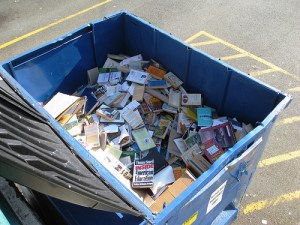
 My post about why I no longer collect books demonstrated once again the significant cultural differences between the two nations I know best, namely the U.S. and Germany (still have a way to go with Canada). Describing my own relationship to the book, using my work in library gift processing as a central formative illustration, created barely a ripple on the western shore of the Atlantic. From conversations with readers over here, it is clear that nothing I wrote upset anyone terribly. Not so from the German side. A notoriously dyspeptic German blogger flamed me, slapping the book burner label on me, even going so far as to wish that there might be a special hell for such heretical librarians. More thoughtful German readers wrote with varying degrees of support or disagreement, but my description of mass book disposal clearly touched a sensitized German nerve. For those who kann, here are some of those responses (one, two, and three).
What I did not address in that post, but will do here, is describe my views on the obligations of libraries to collect books, or, as I commented on one of those German blogs, nearly all books. My view is that this is a collective obligation of libraries, an obligation that transcends both borders and library type. In other words, major research libraries do not bear this burden alone, since even with their broad reach there will be myriad titles that never land in their collections. In nations that have the capital and technical means to build and maintain libraries, there are collectively hundreds of thousands of libraries, ranging from a Canadian prairie town public library to the Harvards of the world. There are special libraries with highly specialized profiles collecting items that the rest of us would find mind-numbingly uninteresting. All of this is good.
A business model in flames?

flickr - Loving Earth
Could it be that after years of persistent advocacy by librarians and a subset of academics that the disgruntlement with the business practices of Elsevier, Wiley, Springer, et al. might be ready to go mainstream? Protests against journal pricing appearing on the digital pages of Wired, Forbes, and The New York Times might just mean we’ve passed the tipping point. Let’s hope.
This wave of protest seems to have been set in motion by the proposed Research Works Act in the United States, which I mentioned recently. It would be delicious irony if such a crass attempt to make open access mandates essentially illegal set in motion the chain of events that finally got a critical mass of researchers marching away from the same old way of doing things. The subtitle of the RWA ought to make any academic or librarian squirm uncomfortably: “To ensure the continued publication and integrity of peer-reviewed research works by the private sector.” Nothing like showing your cards.
Why I no longer collect books
flickr - brewbooks
UPDATE: I recently wrote a companion piece to this post, entitled “why libraries should collect books.”
Apologies in advance to the length of this post. The thoughts and ideas expressed below have been percolating in my head for the last dozen years or so, and it’s time to begin letting them out. Some recent breakfast reading–James Woods’s excellent New Yorker essay on his deceased father-in-law’s library–set the wheels in motion.
Let me begin by making a simple statement: I am a librarian who has no particular affection for the object commonly known as the book. The emphasis here is on ‘object,’ since as texts I have great affection for any number of books. What I am saying is that I do not hold the object to be precious just because it is a book, nor do I believe as do Nicholson Baker and Ranganathan that every book necessarily has its reader. Yes, they are likely correct in a narrow sense, but not to the point to which we librarians often carry the argument in defense of our collections and arcane practices.
Still naughty

flickr - karmablue
It’s been a while since we’ve had a cathartic round of Elsevier bashing in libraryland. Most have come to realize that they are no different from other STM publishers. Nothing like this little bit of news from Wired Magazine to get the ball rolling again.
In a nutshell, two U.S. House members have introduced a bill that would make it illegal for any federal agency to mandate open access policies for research. In other words, the NIH Public Access Policy would be nixed. Clearly publishers are behind this, having already tried once to get such a bill to the floor. This time, the conduit between Elsevier and Washington is clear. The Democratic rep who introduced the bill received no less than 12 contributions from Elsevier executives, only one of whom is an actual constituent. Don’t like it? Write your rep.
What’s particularly interesting to me is the wording of the proposed bill. It reads, in part:
No Federal agency may adopt, implement, maintain, continue, or otherwise engage in any policy, program, or other activity that: causes, permits, or authorizes network dissemination of any private-sector research work without the prior consent of the publisher of such work … (italics mine)
Note that it says publisher without raising the issue of who holds copyright. Many publishers still ask authors to assign the copyright for their articles to the publisher, but some publishers do not, and even if they do, wise authors refuse to sign it over and will in most cases still be published (as SPARC has advocated for years). With this bill, copyright would be taken out of the equation, granting new rights to publishers to prevent authors from making their own choices; put differently, the publishers would receive rights that trump the author’s copyright. Publishers can assert copyright for their form of a published article, i.e.- its particular expression in layout and design, as anyone who uses SHERPA/RoMEO knows, but if the author has not assigned copyright to the publisher, the content in the article remains the author’s to do with as s/he pleases.
Money buys power and influence. We all know that, but read for yourself how noxious this little maneuver is. For anyone attending ALA Midwinter, just remember this when Elsevier and others hand you free stuff, whether a pen, a cocktail, or something more significant. They’re just buying us, too.
CNI Fall 2011 notes

flickr - Mike Miley
After the spring Coalition for Networked Information (CNI) meeting, I posted my fairly raw notes from the sessions I attended. It proved to be a fairly popular post, so I thought I’d do the same for the recent fall meeting. Lots of good speakers, as always. My editorial comments are in italics to differentiate them from the speaker’s words.
CNI Fall 2011 Membership Meeting
Washington D.C.
December 12-13, 2011
Opening plenary
Clifford Lynch, CNI Executive Director
Interest in “big data” is coming on strong. Even popular outside of the academy, e.g.- The Economist. We should remember that some big data isn’t so hard. It’s often small in size and found in places like Excel spreadsheets.
Lynch got a good laugh by asking who should archive medical records for dead people. Libraries or insurance companies? Funny but serious question.
Cloud solutions: points out that bandwidth and the time needed to replicate data is a major issue. Not possible/smart to change vendors casually. Heard this mentioned repeatedly in various talks.
Another ebook casualty?

flickr - cogdogblog
Caveat lector. Good advice for any reader, but particularly when it comes to the fragile world of ebooks. Since publishers sign deals with certain distributors, but not others, one runs the risk of losing the ability to read legally purchased ebooks if a platform goes away or one buys a new device. Sure, ebook warriors would tell me just to reformat the books using some spiffy converter, which may well be possible in most instances, but, really, is that any kind of viable business model? I want to read, not manage my books.
The latest entry in the list of casualties of the ebook struggles may well be the once popular Stanza reader. Stanza was the anti-Amazon when it came out in 2008. Wired Magazine even named it one of the “10 Most Awesome iPhone Apps” for 2008.
Fast forward three years, and one wonders how such a successful app could fail to thrive. A recent code update for iOS 5 broke the app for iOS 4 users (it won’t even load for many), and the days pass without sign of any movement from Lexcycle, the firm behind the app. Their Website shows no updates since 2009, and the Twitter account (@stanza_reader) hasn’t been used since 2010. So much for graceful deprecation.
Unlike some of the reviewers now flaming Stanza for this failure, I’m not particularly upset. It was free, after all, and I was using it to read public domain works, so had no financial investment at stake. I did have something of a readerly investment at stake, however. I had become attuned to how the app worked (brilliant, to be honest), and had a number of books in progress when it borked out a couple of weeks ago. Nothing to get huffy about, but it is curious to see such a hot app dissolve into nothingness. Surely there had to be a way to build a sustainable business model here.
Digital scholarship in libraries
flickr - yesyesnono
Here at MPOW, we’re launching a library-based centre for digital scholarship very soon. Having now spent a number of months looking around at various operations both in Canada and the U.S., it’s struck me how little consensus there is on what these centres should be offering. Places such as the Center for History and New Mediaset the technical bar very high with their ability to develop applications with broad appeal. Others are looking to bring everyone in the academy along so offer support for basic digital publishing and online content creation. There’s nothing right or wrong with either approach, of course, if what one is offering meets a need.
What interests me as a librarian is what happens when these centres develop in libraries. What should these centres offer that leverages existing strengths or builds new competencies where they are clearly needed by researchers? I find this question quite hard to answer, and frankly the answer changes depending on the faculty member with whom I’m speaking. Some are very advanced digital humanists, and need high-octane programming and server support; others are still trying to find the door, so to speak, and just need a friendly hand.
With that in mind, I tossed together a little query on All Our Ideas that asks the question “what should these library-based centres offer” and poses some possible answers. Feel free to cast votes, submit new ideas, and generally tinker around. Thanks!
Amazon vs. WorldCat revisited: getting crushed by the little, big guns

I crush your head – Guiniveretoo – flickr
A couple of years ago, I wrote a post where I criticized OCLC WorldCat.org‘s handling of title searching and result ranking. Quick synopsis: when searching for the book Little, Big by John Crowley, it wasn’t coming up in the top 50 results. Part of the reason for that was that I was in Germany at the time, and clearly OCLC was tweaking the relevance ranking based on the user’s IP address (not a wise idea). I compared the results to Amazon, where a search for the title–without even specifying that it was a book–brought it up in first position.
At the time I made a mental note to rerun the test when back in North America. Took a while, but finally did so today. How did it go? Read more…
Access Conference is livestreaming!
Courtesy of Nick Ruest, who has the good fortune to be there live, I found out that Access 2011 is being livestreamed this year. For years I’ve told anyone in the U.S. who will listen that Access is one of the best bangs for the buck to be found if you want to hear some progressive thinking on a variety of library IT threads, but are intimidated by Code4Lib. It’s not the same as being there, but it’s good to be able to at least get a sense of what’s going on. Many thanks to the organizers!
[The logo is used here without explicit permission, since I could not identify a Creative Commons license on the conference site. I use it under the “I’m plugging your product/universal good” exclusion, which I just made up. If you want me to remove it, I gladly will.]
The Atlas of New Librarianship – a review
Earlier this year, the review editors for portal: Libraries and the Academy asked if I would consider reviewing The Atlas of New Librarianship by David Lankes. I agreed, because I’m generally interested in current attempts to recast libraries, librarians, and librarianship. What emerged and recently appeared in portal (warning: paywall) was a fairly negative review, perhaps made more pointed by the necessity of cuts for space considerations. For those who are interested in reading the submitted version (author’s final version, in the parlance of open access), I’m publishing it here with a Creative Commons license. Please feel free to comment on the review.


 The Bibliobrary