American
I am one. Whether I chose this fate or not, I was born of American parents in a hospital in the US. That makes me an American. Rather than engage in deep analysis of our place on the planet, I want to take on one small linguistic tic that lives on in Germany. It involves understanding exactly what the term American means.
It has only sunk in recently, after many years of hearing it, that in Germany one is frequently corrected for using the adjective amerikanisch or the noun Amerikaner(in) without qualifying it as do many educated Germans, i.e.- US-amerikanisch and US-Amerikaner(in). This occurs both when speaking and when writing, and the correction is typically dispensed with a resigned “you Americans are so ignorant of the world around you” attitude, blithely ignoring the fact that Americans in Germany (or abroad in general) are likely, de facto, not those Americans. This can be annoying, not least since it is irksome to have Germans pronounce in this fashion on the culture and ways of a hemisphere and of a people about which many know not much more than what the media shows them. We all know how accurate media stereotypes are, don’t we (“I know nussing … NUSSING” – ah, Sergeant Schultz, how you shaped my early view of Germany).
Rather than rely on my own sense of the issue, I decided to do a little investigating. Using newspapers from various South and Central American nations, as well as Canadian sources, I checked to see what their editorial standard was for using either the substantive or adjectival form of the term. Here are the results:
- O Estado de Sao Paulo, Brazil: … nenhum americano no Paquistão estaria seguro. (no American would be safe in Pakistan)
- La Nacion, Buenos Aires: El presidente estadounidense se refirió al levantamiento ocasional … (The president referred to the occasional lifting …) [how cool, Spanish can make an adjective out of estados uni] and … a principios de mes por el Departamento de Estado norteamericano … (… earlier this month by the U.S. State Department …) [guess Canada has been booted from North America]
- Globe and Mail, Canada: … keep the lid on violence in advance of an American withdrawal …
- Gazette, Montreal: … but older Americans will recall how closely these tactics copy …
- Journal de Montréal: … à une assemblée sur le système de santé américain au New Hampshire … (… at a meeting on the U.S. health care system in New Hampshire …)
- The Gleaner, Kingston, Jamaica: … but said the addition of American pop stars has done wonders for the show …
Curious about other European nations, I poked around there a bit, too:
- Svenska Dagbladet, Stockholm: … den senaste tiden stått i centrum för meningsbrytningar mellan den amerikanska och den israeliska regeringen … (… recently been in the [differences of opinion?] between the U.S. and the Israeli Government …
- České Noviny, Prague: Americká ekonomika ve druhém čtvrtletí … (U.S. economy in the second quarter …)
- Le Monde, Paris: Téhéran confirme détenir trois Américains (Teheran confirms detaining three Americans) and Le renforcement prévu de la présence américaine en Colombie … (The reinforcement of the U.S. presence in Colombia …)
Other than that cool ability of Spanish to make an adjective out of an otherwise unwieldy country name, it would appear that there is something of a consensus in this small and unscientific sample that the term American, when unqualified, refers to the United States and its people. This seems neither bad nor confusing to me, and certainly not worthy of a correction. After all, the other nations on the western side of the globe have their own names, and seem OK with that: Brazilians, Cubans, Canadians, Mexicans, Nicaraguans, etc. American is simply a convenient shorthand for United States of America. I cannot think of any other nation in the western hemisphere that has the word American in its name, so the qualification is superfluous, not least since languages tend toward economy (i.e.- dispense with superfluous elements).
Even what is arguably the leading German newspaper, the Frankfurter Allgemeine, seems at peace with Amerikaner and amerikanisch. In an article today, I read:
- Die Debatte über einen Umbau des amerikanischen Gesundheitswesens hat mit der parlamentarischen Sommerpause …
Given this, I feel somewhat justified rolling my eyes when told to use “US-amerikanisch.” Lesson not needed, nor wanted. Besides, Wikipedia says it is so.
That last bit is US-American sarcasm, by the way.
UPDATE: Found this very pointed and humorous take on why no one should use “US-Amerikaner” or its derivatives.
Google Insights
I don’t exactly live under a rock, particularly when it comes to Google services. I use gmail, Google Docs, Calendar, Analytics (on various sites), etc., and I also administer a Google Search Appliance for my American employer. Heck, I even discovered a bug in the mail app on my Google-employed brother-in-law’s Android phone (i.e.- I broke the mail app). It surprised me then, that I just ran across Google Insights today, even though it was launched over a year ago.
Insights is something akin to the old Google Zeitgeist page (which now points to Insights, as well as their other tracking tools Trends, Trends for Websites, and Hot Trends), only instead of just seeing lists of the hottest searches, I can now enter terms and see how they fare over time and against other terms. Here’s a visual example from a query comparing library (blue) and walmart (red):

library v. walmart
As with so many Google tools, I wonder when/how they will monetize such a tool. Given that their analysis tools are progressively improving, it can only be a matter of time before they offer enterprise-level solutions while perhaps still giving it away for free to the little people.
Not sure what to make of what Insights is telling me, to be honest, given variant spellings and the vagaries of how Google searches using stems and such. Still, good fun, and true to the name, certain truths do emerge if one digs a bit.
Stop it already, Dr. Müller!
Received yet another offer today from VDM to publish my “thesis,” which is really a short column for an online journal. Their cheek impresses me, but this is spam and should be treated as such.
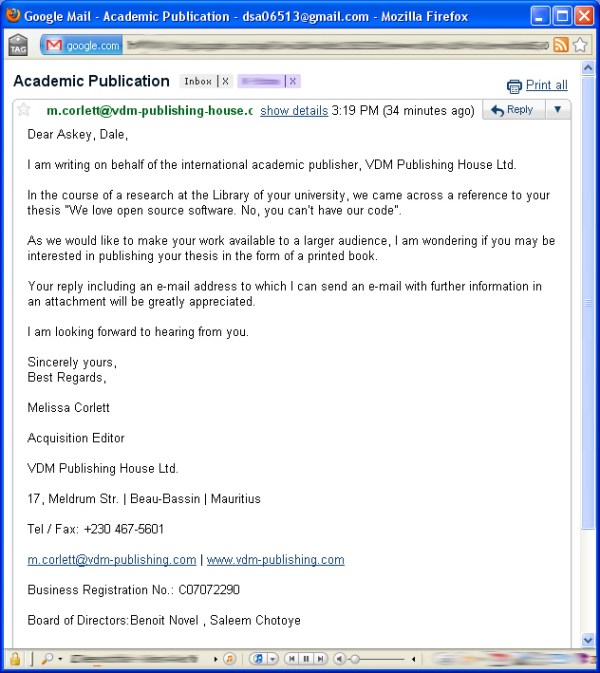
Manuscript fishing
If/when they come knocking, just flag the message as spam in the mail client of your choice. Eventually the message might get through.
eMusic and why the recording industry loses friends
Apparently eMusic’s business strategy is to make extensive use of the bait and switch. I joined their service over a year ago, and for a while I was quite happy. The idea that I could pay around 30 cents a track for music from the periphery (i.e.- no hits, few major bands or limited tracks from same) seemed to make sense given the pricing structure and catalogs of other services. Other advantages were the fact that tracks rolled from month to month, and that one could download the tracks to other machines as often as it pleased one. Related to that, one could always via the download history find tracks that one misplaced and download them again.
Without any notification from eMusic–I haven’t received an email from them for over a year other than in response to explicit support requests–all of those conditions were changed. Most of this is related to the fact that eMusic sold its soul to Sony. Sure, that added a bunch of mainstream music to their catalog, but if I want that, I would use the iTunes music store despite its higher per track price because it has the largest catalog. Here were the nasty surprises eMusic pulled on me:
- My plan no longer exists in the new regime. If I change plans, I cannot go back to it. Guess what: all of the new plans have a higher per track price.
- Many albums are now all or nothing. No more picking the tracks one likes. You either download them all, or none. Another reason to use iTunes.
- With the Sony deal, a large portion of their previous catalog was removed. Surprise! I can no longer download those tracks from my history.
- Even worse, it is now impossible to download the tracks at all from the history. So now one gets one chance to get it right. Lose the track, you have to buy it again.*
- Tracks (oops, they are now credits, and some songs cost more than one credit, another “little” change) no longer roll from month to month. I logged in recently, saw that I had only 30 tracks (the refresh amount from my non-standard plan) and wonderered where the remaining tracks from the previous month had gone. I complained to eMusic’s customer support about this and was told:
- Remember: downloads do not roll over from one billing cycle to the next. It’s use ‘em or lose ‘em!
- Remember? Remember?! What I remember is that when I joined and for a while thereafter, they did roll. What an obnoxious thing to say to a customer.
To try to appease me, their support threw a ten credit bonus pack at me (here, dog, take the bone, good doggie) and then–in a bit of boilerplate only a corporate marketing idiot would ask service agents to put in an email–said that in the new regime I should be happy because the new catalog had nearly 200,000 new tracks added “including many of the most loved names in music like Michael Jackson, Kings of Leon, and Beyonce.” Huh, what? eMusic was about alternative/obscure music, it is why I joined, and you think this will make me happy.
Needless to say, I am going to take the ten tracks, download what remains of what I paid for, and cancel my eMusic subscription. And the recording industry wonders why it is one of the most reviled industries going.
*UPDATE: To be fair, I need to point out that one of my assertions above is wrong. One can still download previously purchased tracks, albeit from the album page, not from the download history. This makes it one step more difficult–if you don’t remember what you downloaded, you have to go to the history, and then search for the album to get the link to download it again–but with a little mucking around, it is possible. Of course, this only works if eMusic still has the content, which after the Sony deal may or may not be the case. I would estimate that nearly 40% of my downloads are no longer hosted by eMusic. I understand why this happens–as a librarian, I know the vagaries of licensed content better than most–but it is still bothersome.
UPDATE to the UPDATE: Well, one can redownload tracks, but only a “reasonable” number of times, whatever that euphemism might mean. While (re)downloading a track today I saw this message:
“eMusic offers limited re-downloads, without charge, when a track or album fails to download correctly or is corrupted …”
The way they sold their service in the old regime was to tout that one could download again and again. This is very useful for those of us who work at multiple computers in various places and own various devices. It is perfectly legal for me to have a copy of a song I have purchased on all machines owned by me.
Student video project
One of my classes this last semester was video production for library students. Those of you who know me can now stop laughing and continue reading. Video production was never my strong suit, although I did make an A-winning and gripping documentary on the Yalta conference back in 1988.
The students divided themselves into two groups and made two very different and excellent videos. I just got the word from “Team Text” that the final version of their video is now up on YouTube, so it is now ready for prime time. Watch and enjoy (but it helps if you can understand German–if not, you will still get the point, I think, so well made it is). I encourage you to watch it in HD and full screen, too.
Cost of humanities journals
A recent article in the Chronicle of Higher Education (sorry, must subscribe to see full article) reports on research that asserts that it costs leading humanities journals nearly $10,000 to publish and article. I will withhold unbridled mocking of such absurdity until the full report appears on the National Humanities Alliance Website, but this surely says much more about the bloated bureaucracy of organizations such as the Modern Languages Association and the American Historical Association than it does about the actual costs of publication.
Had the research been done sensibly across a representative spectrum of humanities journals (including those already published open access), which would seem to be what a study that purports to show the cost of publication in humanities journals would do, not only would the figure have been significantly lower, but it would have actually been a useful study for those of us engaged in the publication of humanities journals. What we have instead is more Mellon-funded navel gazing, with a self-important funding agency funding a self-important lobbying group to do research on a handful of self-important journals published by self-important and (clearly) inefficient societies. Sure, publishing in the PMLA is special, but let’s accept the fact that important scholarship is published elsewhere and while such titles cannot be ignored, they are not the be all and end all of publication in the humanities. To assert otherwise is inane.
Perhaps the report will enlighten us all, but what on god’s green earth is this money being spent on? Given that editors and reviewers work pro bono in the humanities, it sounds to me like the societies are creating a bureaucracy that serves and feeds upon itself.
Urheberrecht in 3sat
Ein kurzes Video zum Thema Urheberrecht und der Streit zwischem dem Ulmer Verlag und der UB Darmstadt:
http://www.3sat.de/mediathek/mediathek.php?obj=13385&mode=play
Ich finde Ulmers Drohung, zukünftig keine Lehrbücher mehr zu veröffentlichen recht kindisch, aber leider allzu typisch für einen deutschen Verlag. Mensch, alles ist nicht schwarz-weiß, und solche apokalyptische Aussagen helfen gar nicht.
(Danke, Gerd, für den Hinweis!)
Why Twitter?
A librarian colleague of mine recently asked me (via Twitter) what the advantages of using Twitter are. Rather than try to reply to him in 140 characters or less, I thought I would write it out more fully using this now dated technology called blogging.
It took me a long time and several attempts to grasp the utility and potential of Twitter. At first I found it difficult to remember to use, and didn’t see the point in reading tidbits about random people. A lot of people are having a grand time making fun of Twitter, and there is certainly a lot of inanity inside any of the social networking ecospheres. As with any technology of this nature, however, there is also a positive, useful side, or at least there will be until Twitter is overwhelmed with spammers who will ruin it for everyone.
Who in this day and age has the time they would need to communicate with everyone with whom they want/need to communicate? Our physical and cognitive abilities have changed little since, say, the 16th century, but the demands placed on us have, and profoundly. In the 16th century, one likely lived and died within an incredibly small geographical area, where personal contact via the human voice was inevitable and was the means of transmission for all information. Eventually, literacy began to become more universal, and printed forms of information began to spread, which added a new dimension and expanded the horizon, at least for some. In the 19th century, we saw the rise of commercial postal systems, which allowed one to send information long distances.
Much later, along comes the telephone, and with it the ability to speak across long distances. Of course, it is still one to one communication and predicated upon the concept that our social and professional spheres can be managed using a synchronous technology that requires (more or less) our full and undivided attention.
In the last 20 years, technology has literally exploded this tidy universe and nearly overwhelmed us. Cell phones are ubiquitous and obnoxious, and yet we cannot live without it seems. Email has become a necessity, and at least begins to move us in the direction of asynchronous communication (a la the postal systems, which have all but disappeared except as a means to send bills, three-dimensional non-textual objects, and unwanted advertisements). You can write to me whenever you want, and I choose when and if to respond. Around the same time, instant messaging came on the scene. It has the advantage of allowing us to have syncopated synchronous conversations, i.e.- we can likely chat with someone while doing something else, dropping in and out of the exchange in a way that would be rude on the phone.
Add to this already volatile mix things like the blogosphere (fed to us incessantly via RSS) and now microblogging services such as Twitter, and things get a bit out of hand, perhaps. There have been studies, and surely there will be many more, about how much time and energy we modern tech-savvy humans spend on creating and consuming information using these various channels. It is a lot, and the question is whether the benefits outweigh the costs. I would argue they do.
The “problem” with the telephone is that it requires my full attention. If you call me to ask a question that is important to you, but trivial to me, I will likely be annoyed by the call. I would have preferred an email that I could answer at my convenience. But email is also not perfect. How many of us have stacks of messages in our inbox (usually of the more social sort) that we need to answer but never seem to find the time to do so? Chat? My heavens, it is time intensive, and I do it only with close friends and colleagues for the most part.
Basically, what it comes down to is that in my complex modern life, where I have worked for numerous employers, lived in many cities on two continents, and engaged in generally social behavior wherever I have been, I have long since lost the ability to communicate with everyone I know in a reasonable fashion using the more time-intensive technologies such as the phone and email. I try, valiantly, but alas go off the rails all the time. Hence I choose to blog, not to be an exhibitionist for all, but to share with friends and acquaintances some bits out of my life that might interest them. If not, I will never know, and they need not worry about insulting me if they skip something or ignore it entirely.
Twitter fits into this mix, and allows me to keep tabs on a wide range of people, both personal and professional contacts, with whom I otherwise might not be able to maintain a more time-intensive exchange. I learn about articles and conferences from colleagues (like a large, low-time-cost reading circle), learn about major life events (hey, we had a kid, for example), and trade snippets about current events (such as the Tour de France) without having to invest in cohesive narrative threads via email or some other technology. I spend, at most, ten to fifteen minutes a day on Twitter, and can easily see the advantages it brings. I feel caught up, as if I have feelers out there in various circles and can pick up the interesting and important tidbits.
It’s not a perfect technology, and I can see it easily evolving into something else, but there is something about one to many communication that has caught the fancy of our modern society, and I doubt that that is going to go away anytime soon.
Open access: stay on message
Last week the HTWK sponsored a day of talks on and around the topic of open access. Good talks, and many thanks to those who travelled to Leipzig to enrich our students.
I had the opportunity to hear the talks by Arne Upmeier, subject librarian at the TU Ilmenau library, and Achim Bonte, associate director of the SLUB in Dresden. Both did an effective job of covering a great deal of material in a fairly short window, and of making it interesting for students.
There were a couple of points, however, where I squirmed in my seat based on a couple of points they made. What I would like to do here is respond to those points, and invite commentary from any readers. Read more…
Wow, someone wants to publish me!
Update: if you’ve found this old post and are interested in learning more about VDM, please see my translation of Nina May’s interview of Wolfgang Müller.
Does that sound sarcastic? It should.
The noxious German vanity publisher VDM Verlag Dr. Mueller has apparently cooked up a script (I speculate) to troll various institutional repositories and spam the authors of items found therein with offers to publish their theses. Here’s the text of the second such overture from VDM to me, which, amazingly (yes, more sarcasm), reads exactly as a “personal” message from Melissa Corlett, VDM’s Acquisitions Editor, sent to a colleague of mine in the US the other day. All errors, poor formatting, and missing punctuation are hers/the script’s. Read more…


 The Bibliobrary